

There was a time when reaching the C-suite or scaling a multi-million-dollar enterprise meant you had legitimately “arrived.” You had the track record, the corner office, and perhaps an MBA hanging on your wall. Learning was done on the fly, distinguished through boardroom battles and economic cycles.
Today, that playbook is being rewritten.
According to recent data from the National Center for Education Statistics, conferred business doctorates jumped by nearly 21% in a single year. Meanwhile, global leadership studies reveal that 81% of Doctor of Business Administration graduates achieve significant career advancement within two years of completing their degree.
What many are looking for now is something different: a stronger framework for understanding why certain business decisions work, how to investigate complex organisational problems, and how to turn years of professional experience into deeper expertise.
So why are established leaders, already pressed for time, choosing to become students again?
The answer lies in a fundamental shift in what modern corporate survival needs.
Experience Is Respected, but the Business Environment Keeps Changing
Artificial intelligence is changing workflows. New technologies are shortening business cycles. Sustainability is moving into boardroom conversations. Global supply chains remain vulnerable to geopolitical disruption. Employees have different expectations of leadership, flexibility, and workplace culture. The scale of this transition is substantial.
The World Economic Forum’s Future of Jobs Report 2025 estimates that 22% of today’s jobs will experience disruption by 2030. It forecasts 170 million new roles and 92 million displaced roles, producing a net increase of 78 million jobs worldwide. More importantly for business leaders, almost 40% of skills required at work are expected to change by 2030.
This is not just an employee reskilling issue. It is a leadership question.
Executives have to decide which technologies deserve investment, which skills their organisations need, how people should be reskilled, and where the next competitive threat might emerge. Experience can guide these decisions. But experience combined with planned research can make that thinking significantly stronger.
Transforming Workplace Friction into Intellectual Property
One of the most compelling reasons executives return to university for a DBA is the opportunity to solve a specific, high-stakes problem they face on the job. Surveys by the Business Science Institute show that 87% of DBA graduates use their doctorate research to directly solve a strategic or operational crisis within their company.
Consider these real-world executive focus areas:
- A FinTech CEO researching how machine learning models impact consumer trust in cross-border payments.
- A Healthcare Vice President evaluating change-management strategies during digital transformation.
- A Supply Chain Director building a predictive risk framework to buffer against geopolitical disruptions.
Instead of paying millions to peripheral management consultants, executives become the ultimate subject-matter experts within their sector. The research generated during a Doctor of Business Administration often evolves into proprietary operational strategies, patents, published industry reports, or even new enterprise spin-offs.
The Doctor of Business Administration Is Not About Starting Again
A decade ago, pursuing a doctorate while running a company was virtually impossible. It meant pausing a career or commuting to campus numerous days a week. One reason experienced professionals may hesitate to return to university is the fear of going backwards. After years of making real decisions, sitting through basic lessons on management theory may hold little appeal. A DBA takes a different approach.
The Doctor of Business Administration is a doctorate-level business qualification generally designed around the application of research to complex business and management challenges. Rather than separating academic thinking from professional practice, DBA study can allow experienced professionals to examine issues carefully connected to their industries, organisations, or areas of expertise.
Consider the questions senior professionals frequently encounter:
- Why does a transformation strategy succeed in one organisation and fail in another?
- How should companies redesign leadership practices when AI becomes part of everyday work?
- What influences employee retention across culturally diverse teams?
- How can a family-owned enterprise scale internationally without losing its organisational strengths?
- What makes consumers trust one digital brand over another?
These are not questions, with simple textbook answers. They need investigation, evidence, critical analysis, and context. That is where doctoral-level business study becomes relevant.
What Modern Online DBA Programmes Offer:
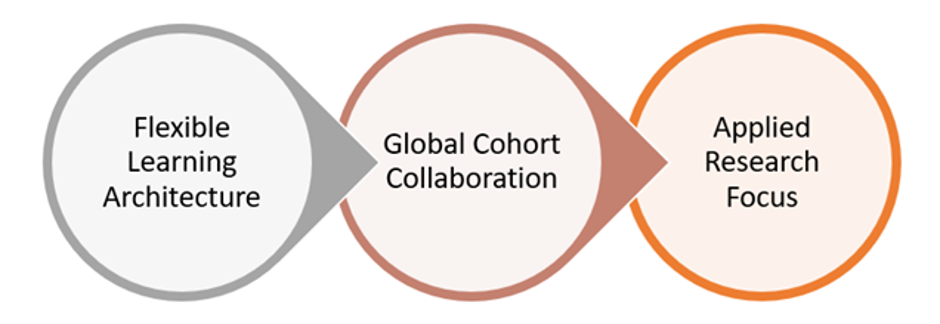
This flexibility allows leaders to integrate academic rigor into their daily workflow immediately, rather than waiting three years to see the return on investment.
The Career Market Is Gratifying Higher-Level Business Competence
The broader employment outlook also provides useful context. Although labour-market conditions vary extensively by country, the U.S. Bureau of Labor Statistics projects management occupations to grow 6.1% between 2024 and 2034, adding approximately 833,400 jobs. That is almost twice the 3.1% projected growth rate for all occupations in the same period.
Worldwide, the picture is more complex, but the direction is clear: organisations need professionals capable of navigating technological, economic, demographic, and organisational change. A DBA should not be viewed simply as a ticket to a promotion. For established professionals, its value may lie in expanding the kinds of roles they can credibly pursue.
A CEO may want to move into advisory work. An entrepreneur may want to become an authority within a specialised industry. A senior executive may be considering consulting, teaching, research, board positions, or thought leadership later in their career. Doctorate study can become part of that transition from managing within a field to contributing knowledge to the field.
Entrepreneurs Have Their Own Reasons for Pursuing a Doctor of Business Administration
For founders, the motivation can be somewhat different. Entrepreneurs are naturally exposed to experimentation. They launch, test, fail, adjust, and try again. That creates huge practical knowledge.
What they may not always have is an organised way to study what they have observed. Suppose an entrepreneur has spent 12 years building businesses across emerging markets. They may have developed valuable insights into consumer behaviour, digital adoption, financing, or cross-cultural management.
A DBA provides an opportunity to examine such observations methodically. The result is not merely another business idea. It can be a body of research that connects professional experience with wider business knowledge. For founders who eventually want to consult, mentor, teach, publish, advise companies, or influence industry conversations, that ability can become particularly meaningful.
It is easy to focus on the doctoral title. For many experienced professionals, however, the more lasting benefit may be how the process changes their thinking.
After years in business, leaders often become extremely good at making decisions quickly.
Doctorate research asks them to do something equally valued: slow down long enough to investigate a problem appropriately.
- What evidence supports this assumption?
- What evidence contradicts it?
- Is the problem being measured correctly?
- Does correlation really suggest causation?
- Would this strategy work in another market?
- Whose perspective is missing from the analysis?
Those habits can influence far more than a dissertation. They can change how leaders evaluate investments, assess risks, understand reports, challenge consultants, question technology, and make tactical decisions.
Is a Doctor of Business Administration the Right Move for Your Leadership Journey?
If you find yourself facing strategic challenges that traditional management tools can’t solve, or if you want to establish yourself as an undisputed authority in your field, a doctorate may be your next strategic move. Through an online DBA programme, modern executives no longer have to choose between advancing their enterprise and advancing their intellect. They can do both – shaping not just the future of their businesses, but the future of international industry standard practices.




Leave a Reply
You must be logged in to post a comment.